Cf53 / C53G / 1.1213 Steel Tube | SAE 1055 Reference Surface-Hardening Steel
PRODUCT DESCRIPTION
Cf53 / C53G / 1.1213 is a carbon steel suited to induction or flame surface hardening where a hard surface and a tougher core are required. Saf Çelik evaluates this material in steel-tube form.MATERIAL INFORMATION
Cf53 / C53G / 1.1213 Steel Tube
Cf53, historically designated C53G and identified by material number 1.1213, is a medium-to-high-carbon non-alloy special steel. It is particularly suited to components that require induction or flame surface hardening, combining a hard, wear-resistant surface with a tougher core.
Cf53 may be referenced as SAE 1055 in international comparison sources, while some comparison tables also cite SAE 1050. These references do not create automatic equivalence or certificate interchangeability. The specified material number, chemical analysis, product standard, delivery condition and EN 10204 3.1 certificate must govern every order.
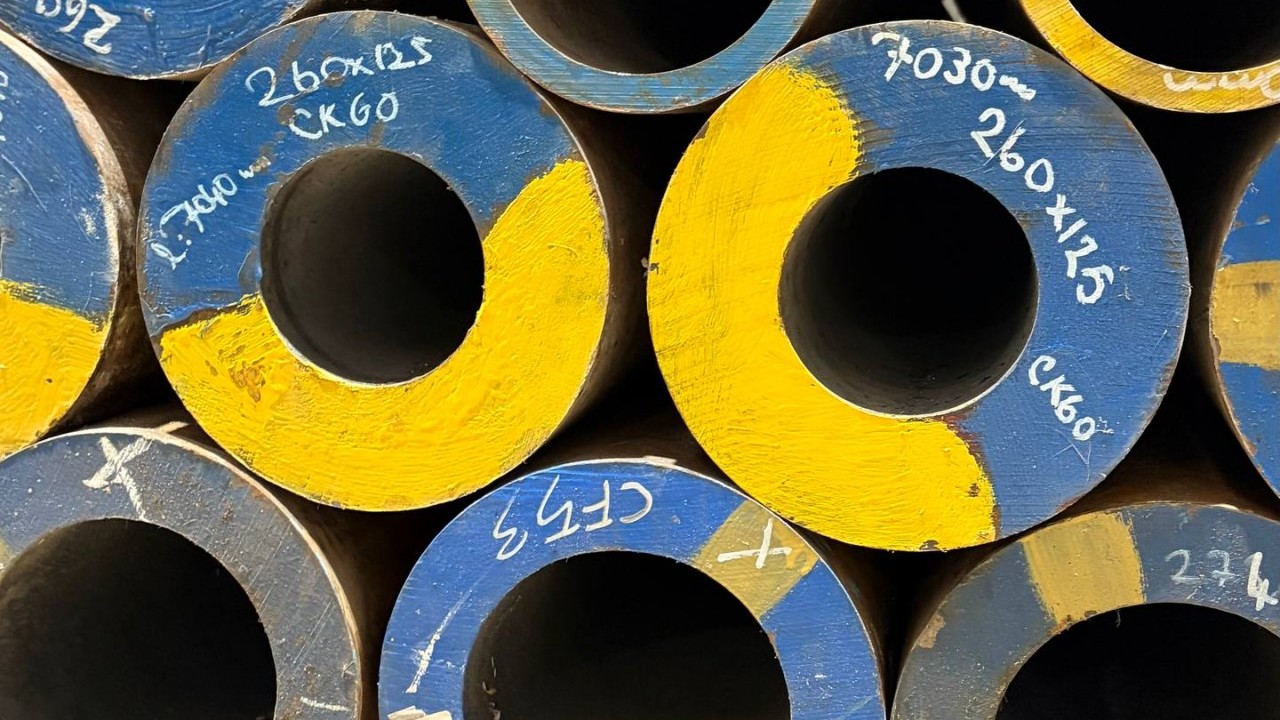
Saf Çelik evaluates Cf53 in steel-tube form. Manufacturing route, outside diameter, wall thickness, length, surface condition, delivery condition and certification suitability must be confirmed lot by lot during quotation.
Principal Designations
| Designation | Information |
|---|---|
| Material designation | Cf53 / C53G |
| Material number | 1.1213 |
| Historical standard | DIN 17212 |
| Searchable international reference | SAE 1055; SAE 1050 in some comparison tables |
| Product form | Steel tube |
| Main processing approach | Induction or flame surface hardening |
Chemical Composition
| Element | Composition (%) |
|---|---|
| Carbon (C) | 0.50 – 0.57 |
| Silicon (Si) | 0.15 – 0.35 |
| Manganese (Mn) | 0.40 – 0.70 |
| Phosphorus (P) | max. 0.025 |
| Sulphur (S) | max. 0.035 |
Surface-Hardening Capability
The approximately 0.50–0.57% carbon content makes Cf53 suitable for induction and flame surface-hardening applications. A correctly controlled process can provide a hard, wear-resistant surface while retaining a tougher supporting core.
Reference data indicate a hardness range of approximately 57–62 HRC after quenching. This is not the as-supplied hardness of the tube. Actual hardness depends on outside diameter, wall thickness, heating method, hardening depth, cooling medium and tempering practice.
Reference Mechanical Properties in Quenched-and-Tempered Condition
The values below are general Cf53 material references and must not be treated as certified mechanical properties for a particular tube.
| Section size | Yield strength Rp0.2 | Tensile strength Rm | Elongation A5 | Reduction of area Z | Impact energy |
|---|---|---|---|---|---|
| ≤ 16 mm | ≥ 510 MPa | 740 – 880 MPa | ≥ 12% | ≥ 25% | ≥ 21 J |
| 17 – 40 mm | ≥ 430 MPa | 690 – 830 MPa | ≥ 14% | ≥ 35% | ≥ 21 J |
| 41 – 100 mm | ≥ 400 MPa | 640 – 780 MPa | ≥ 15% | ≥ 40% | ≥ 21 J |
Heat-Treatment Reference Data
| Operation | Reference temperature |
|---|---|
| Hot working | 850 – 1050 °C |
| Normalizing | 830 – 880 °C |
| Soft annealing (+A) | 650 – 700 °C; approximately max. 223 HB |
| Stress relieving | 120 – 200 °C |
| Hardening | 810 – 845 °C, oil or water quench |
| Tempering | 550 – 660 °C |
These values are technical starting references only. The heat-treatment route must be validated by a competent heat-treatment provider for the actual tube geometry, wall thickness, required hardening depth and service conditions.
Machining and Welding
Cf53 can be machined in soft-annealed or suitably pre-treated condition. For surface-hardened parts, the sequence of rough machining, heat treatment and final grinding should be planned to control distortion and final surface quality.
Due to its carbon level, Cf53 has limited weldability. Welding should not be regarded as a default fabrication method; where necessary, the welding procedure, preheating, controlled cooling and any post-weld heat treatment must be defined by a qualified specialist.
Typical Applications
- Induction-hardened shafts and sleeve-type components
- Gear shafts, cam mechanisms and drive components
- Wear-loaded machine parts
- Piston-pin, connection-pin and chain-pin type components
- Mechanical parts requiring a hard surface and tougher core
- Special machine components machined from tube form
Quotation and Certification Note
For Cf53 / C53G / 1.1213 steel tube, please specify outside diameter, wall thickness, length, tolerances, manufacturing route, surface condition, delivery condition, required heat treatment and certification expectations. The material must not be used for boiler, pressure-vessel or safety-critical applications until the relevant product standard and certification requirements have been confirmed.