11SMnPb30 Free-Cutting Steel | 1.0718 / 9SMnPb28 / SAE 12L14 Cold-Drawn Steel
PRODUCT DESCRIPTION
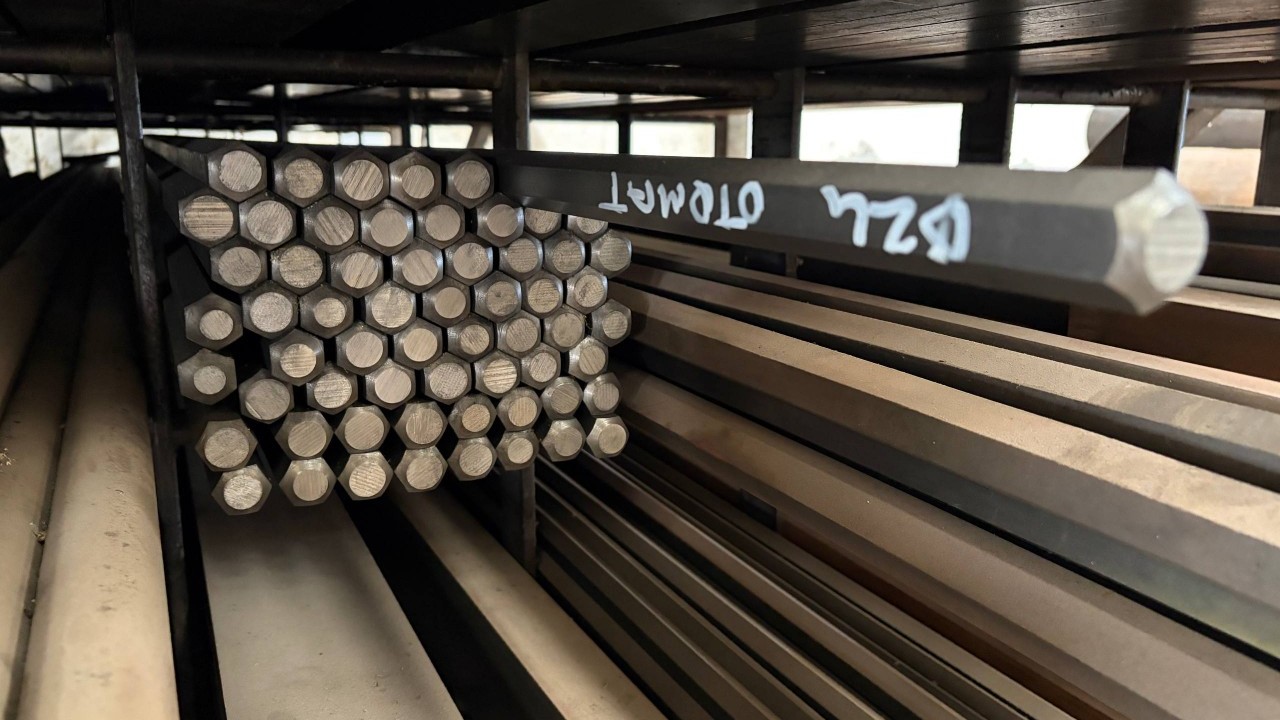
11SMnPb30 / 1.0718 is a leaded cold-drawn free-cutting steel that supports short chip formation, high machining speeds and good surface finish in serial-machined parts.MATERIAL INFORMATION
11SMnPb30 Free-Cutting Steel | 1.0718 / 9SMnPb28 / SAE 12L14
11SMnPb30 is a leaded free-cutting steel developed for serially manufactured components requiring high machinability. This grade has material number 1.0718, is known as 9SMnPb28 in former DIN terminology, and is often compared with approximately SAE/AISI 12L14 in the United States.
Its elevated sulfur and lead contents support short, controlled chip formation in the cutting zone. This helps achieve high machining speeds, longer tool life and good surface finish in turning, CNC automatic lathes, multi-spindle lathes and other high-volume machining applications.
Material Designations and References
| Designation | Reference | Description |
|---|---|---|
| 11SMnPb30 | EN grade designation | Leaded free-cutting steel developed for high machinability |
| 1.0718 | Werkstoff number | Material number for 11SMnPb30 |
| 9SMnPb28 | Former DIN designation | Historical German reference for 11SMnPb30 |
| SAE/AISI 12L14 | US reference | Close international comparison reference; not an automatic certificate equivalence |
| SUM24L | JIS reference | Close Japanese free-cutting steel reference |
Technical note: 11SMnPb30, 9SMnPb28 and 12L14 may be considered close references in many applications. Their chemical limits, product forms, delivery conditions and certificate requirements can differ, so the full grade and standard should be stated in the order.
Chemical Composition
| Element | Composition (%) |
|---|---|
| Carbon (C) | max. 0.14% |
| Silicon (Si) | max. 0.05% |
| Manganese (Mn) | 0.90 – 1.30% |
| Phosphorus (P) | max. 0.110% |
| Sulfur (S) | 0.270 – 0.330% |
| Lead (Pb) | 0.200 – 0.350% |
Lead and manganese-sulfide inclusions help chips break more easily during cutting. This structure makes 11SMnPb30 advantageous for high-speed machining, while limiting its suitability for welding, hot forming, high-impact service and applications requiring high fatigue resistance.
Cold-Drawn Delivery Condition and Mechanical Properties
11SMnPb30 can be supplied as bright steel in cold-drawn (+C), peeled or other appropriate delivery conditions. In cold-drawn condition, reference mechanical values vary by section size as follows:
| Nominal Section | Yield Strength Rp0.2 | Tensile Strength Rm | Elongation A5 |
|---|---|---|---|
| >5 – 10 mm | min. 440 MPa | 510 – 810 MPa | min. 6% |
| >10 – 16 mm | min. 410 MPa | 490 – 760 MPa | min. 7% |
| >16 – 40 mm | min. 375 MPa | 460 – 710 MPa | min. 8% |
| >40 – 63 mm | min. 305 MPa | 400 – 650 MPa | min. 9% |
| >63 – 100 mm | min. 245 MPa | 360 – 630 MPa | min. 9% |
These are reference values for the cold-drawn (+C) condition. Final mechanical properties must be confirmed according to the ordered diameter, delivery condition and product certificate.
Machining Advantages
- Short and controlled chip formation
- Efficient machining at high cutting speeds
- Suitability for automatic lathes and CNC turning applications
- Potential for good surface finish
- Potential to reduce cycle time in serial production
- Structure that can help reduce tool wear and chip entanglement
11SMnPb30 is especially suitable for small and medium-section turned parts produced in high quantities. Its lead content supports machining performance by providing an internal-lubrication-like effect in the cutting zone.
Welding, Heat Treatment and Application Limits
11SMnPb30 is not a welding construction steel. Because of its high sulfur, phosphorus and lead contents, its weldability is limited and it is generally not recommended for welded fabrication.
This grade is not designed as a quenched-and-tempered steel for obtaining high hardness or high core strength. For heat-treated parts, heavily impact-loaded components, high-fatigue applications or safety-critical service, a more suitable steel grade should be selected.
- Not recommended for welded construction.
- Not a primary choice for components requiring high impact toughness.
- Not suitable for critical shafts under high fatigue or dynamic loading.
- Pressure equipment, lifting equipment and safety-critical applications require the applicable certified grade and project specification.
Lead Content and Compliance Note
11SMnPb30 contains lead intentionally to improve machinability. Suitability must therefore be checked separately for food-contact products, drinking-water systems, medical devices, children’s products, environmentally restricted components or applications governed by special export requirements.
Compliance with REACH, RoHS, ELV or customer-specific requirements depends on the final product, destination country and any applicable exemptions. The customer’s technical specification and compliance expectations should be shared before ordering.
Applications
- Serial components produced on automatic and CNC lathes
- Bolts, nuts, screws, pins and connection elements
- Fittings, adapters, valve components and bushes
- Small mechanical equipment and apparatus parts
- High-volume machined components for automotive and machinery manufacturing
- Precision turned parts requiring good surface finish and short chip formation
Frequently Asked Questions
Are 11SMnPb30 and 12L14 the same steel?
11SMnPb30 / 1.0718 and SAE/AISI 12L14 are close international references. Direct equivalence must not be assumed without checking the exact chemical limits, product form and certificate requirements.
Can 11SMnPb30 be welded?
It is not recommended for welded fabrication because of its high sulfur, phosphorus and lead contents. If welding is unavoidable, it must be addressed through an approved welding procedure and technical risk assessment.
Is 11SMnPb30 suitable for heat treatment?
11SMnPb30 is not designed for quenching-and-tempering or high-hardness heat-treatment applications. Its main advantage is high machinability and short-chip performance.
Why is 11SMnPb30 supplied cold drawn?
Cold-drawn material can provide a smoother surface, better dimensional control and a bright-steel finish suitable for high-speed machining.
Request a Quote from Saf Çelik
For 11SMnPb30 / 1.0718 free-cutting steel, please share the required product form, diameter or section, length, quantity, delivery condition, tolerance and certificate requirement. Saf Çelik can help identify the appropriate cold-drawn free-cutting steel option for your high-machinability production needs.